

Is it Really Worth Updating my Estate Plan?
An estate plan can feel like a finished project—a box checked off a long list of life’s responsibilities. Years ago, you made thoughtful decisions, signed the documents, and put them away for safekeeping, confident you had protected your family’s future. But what if that sense of security is based on an outdated map?
A plan drafted when your children were toddlers is likely ill-suited to guide your family now that they are adults. A business you started after signing your will may not be addressed at all, leaving its fate to chance.
One recurring question is about the cost-benefit: “Is it really worth updating my estate plan?”
It is a valid question. After all, you have already invested time and resources to create a plan. Why should you have to revisit it?
The simple answer is that an estate plan is not a static document. It is a living set of instructions that must adapt to the changes in your life, your finances, and the law. Neglecting to update it can have profound financial and emotional consequences for your loved ones, turning a tool designed for protection into a source of conflict and loss.
The Financial Toll of an Outdated Plan: Understanding Probate
When an estate plan is outdated or non-existent, the default process for settling an estate is probate. Probate is the court-supervised legal process of validating a deceased person’s will, paying their debts, and distributing their assets to the rightful heirs. While it sounds straightforward, probate can be a lengthy, expensive, and public process. The costs associated with probate are paid directly from the estate, which means the more it costs, the less your beneficiaries will receive.
These costs are not trivial. They can include court filing fees, executor compensation, accounting fees, and, most significantly, attorney fees. While these costs vary by state and the complexity of the estate, research provides a clear picture of the financial burden.
A Breakdown of Probate Costs
Several factors influence the total cost of probate, including the size of the estate, the state where the probate is conducted, and whether any part of the plan is contested. Here are some of the most common fees involved:
| Fee Category | Description | Typical Cost Range |
| Court Filing Fees | The initial fee to petition the court and begin the probate process. | $50 – $1,200 |
| Executor Fees | Compensation for the person responsible for managing the estate. | 3-5% of the estate value |
| Attorney Fees | Legal fees for guiding the executor through the probate process. | Varies (hourly, flat fee, or percentage) |
| Other Costs | Fees for appraisals, business valuations, notaries, and postage. | Varies |
Visualizing the Impact: What Probate Really Costs Your Heirs
To truly understand the financial toll of probate, it helps to see the numbers in context. The chart below illustrates how probate costs accumulate across different estate sizes and, more importantly, what percentage of your legacy is lost to fees rather than going to your loved ones.
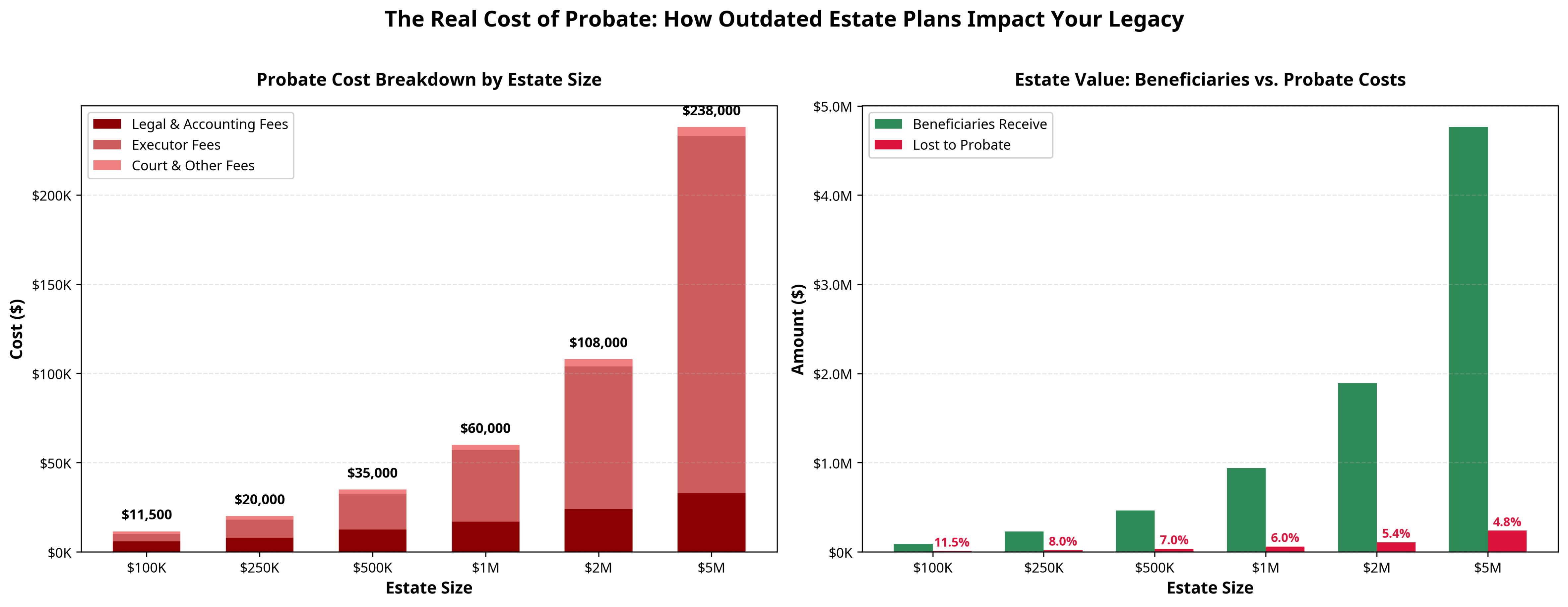
As the charts demonstrate, even a modest estate of $100,000 can lose over $11,500 to probate costs; that is 11.5% of the total estate value that will never reach your beneficiaries. For a $1 million estate, the costs can exceed $60,000, representing 6% of the estate.
While the percentage may decrease slightly for larger estates, the absolute dollar amounts become staggering. A $5 million estate can lose nearly $238,000 to probate fees alone, money that could have been preserved for your heirs with proper planning.
These figures represent conservative estimates based on national averages for uncontested probates. If your estate involves disputes, complex assets, or beneficiaries who cannot be easily located, the costs and timeline can increase dramatically.
The Hidden Costs: Time and Emotional Strain
Beyond the direct financial costs, the time and emotional toll of probate can be even more taxing on a grieving family. The average time to settle an estate without a proper plan is a staggering 24 months. This prolonged period of uncertainty can create significant stress and delay the distribution of assets to your loved ones who may be depending on them.
The probate process itself is a series of deadlines and legal requirements that can be overwhelming for an executor to handle alone. A best-case scenario for an uncontested probate still takes a minimum of nine months to navigate the required notices, creditor claim periods, and final filings. In reality, it often takes much longer.
This is time spent locating assets, notifying beneficiaries, paying bills, filing taxes, and navigating a court system that can be confusing and unforgiving. When an estate plan is outdated, the process becomes even more complicated. Ambiguities in the documents can lead to disputes among family members, turning a legal process into a painful family drama. These court battles are not only expensive, but they can also create lasting divisions among your loved ones, a legacy no one intends to leave.
The Impact of Economic Uncertainty on Estate Planning
Recent economic conditions have also prompted many Americans to reconsider their estate planning strategies. With inflation and rising costs affecting the value of assets and the purchasing power of inheritances, 42% of Americans are now rethinking their estate planning.
This shift in perspective underscores an important truth: your estate plan is not just about distributing what you have today, but about ensuring that your legacy maintains its intended value and impact for your beneficiaries tomorrow.
Inflation can erode the value of fixed dollar amounts specified in your plan. A gift that seemed generous a decade ago may no longer have the same purchasing power today. Similarly, the federal estate tax exemption and other tax thresholds change over time, which can affect the tax efficiency of your plan. Regular reviews allow you to adjust for these economic realities and take advantage of new planning opportunities that may have emerged since your plan was first created.
The Solution: Proactive Updates and Modern Planning Strategies
The good news is that the costs, delays, and emotional strain of probate can be largely avoided with proactive estate planning. The cost of updating an estate plan is a fraction of the cost of a contested or complicated probate. Modern estate planning offers a variety of tools and strategies that can help you streamline the process and ensure your wishes are carried out efficiently and privately.
One of the most powerful tools for avoiding probate is a revocable living trust. A trust is a legal entity that holds your assets for your benefit during your lifetime and then transfers them to your designated beneficiaries upon your death, without the need for court intervention. 42% of Americans are unaware that trusts can avoid probate. Trusts are not just for the wealthy; they are a flexible and effective tool for families of all income levels to protect their assets and their privacy.
Beyond avoiding probate, trusts offer additional benefits that make them an attractive option for many families. They provide continuity of asset management if you become incapacitated, allowing your designated trustee to step in and manage your affairs without the need for a court-appointed guardian.
Trusts also offer protection for beneficiaries who may not be ready to manage a large inheritance, such as young adults or individuals with special needs. By placing assets in a trust with specific distribution instructions, you can ensure that your beneficiaries are provided for in a way that protects them from their own inexperience or from outside pressures like creditors or divorce proceedings.
Other strategies to avoid probate include:
- Payable-on-Death (POD) and Transfer-on-Death (TOD) Designations: These allow you to name a beneficiary for your bank accounts and investment accounts, transferring the assets directly upon your death. These designations are simple to set up and can be changed at any time, making them a flexible option for many types of accounts.
- Joint Ownership of Property: Owning property jointly with rights of survivorship ensures that the property automatically passes to the surviving owner. This is a common strategy for married couples, but it can also be used for other relationships where shared ownership makes sense.
- Beneficiary Designations on Life Insurance and Retirement Accounts: These designations override your will, so it is vital to keep them updated. A common mistake is to name a former spouse or a deceased individual as a beneficiary, which can lead to unintended consequences and potential legal disputes.
Is It Really Worth It?
So, is it really worth updating your estate plan? The answer is yes. When you weigh the modest cost of updating your plan against the potential financial and emotional toll of an outdated or non-existent plan, the value becomes clear. An update typically involves a consultation with an attorney to review your current documents, discuss any life changes, and make the necessary adjustments.
More importantly, updating your estate plan is an act of love and responsibility. It is a way of ensuring that the people you care about most are protected and provided for according to your wishes. It is a way of preventing conflict and confusion during an already difficult time.
Think of your estate plan as a living document that grows and changes with you. Just as you would not drive across the country with a decade-old map, you should not rely on an outdated estate plan to guide your family through one of the most important transitions they will ever face. Regular reviews and updates are not just recommended; they are necessary to ensure that your plan remains effective and aligned with your current circumstances and goals.
Secure Your Legacy by Keeping Your Alabama Estate Plan Current
Your estate plan is one of the most important gifts you can give your family. It provides clarity, minimizes conflict, and protects their financial well-being during a difficult time. However, that gift loses its value if it is not maintained. A regular review ensures that your plan continues to reflect your wishes and will work as intended when it is needed most.
The legal team at Stone Crosby, P.C. is dedicated to helping clients across Alabama create and maintain effective estate plans that stand the test of time. We provide thoughtful guidance to help you navigate life’s changes with confidence, ensuring your legacy is preserved for future generations. Contact us today at (251) 336-3698 to schedule a personalized consultation to review and update your estate plan.